A garden room turned dedicated home cinema in Gloucester. The client supplied their preferred audio kit; we delivered the room around it — interior and lighting design, acoustic treatment effective to ~60Hz, a floating front-wall feature, and a 7.1.2 Atmos layout calibrated in-room with Marantz processing.
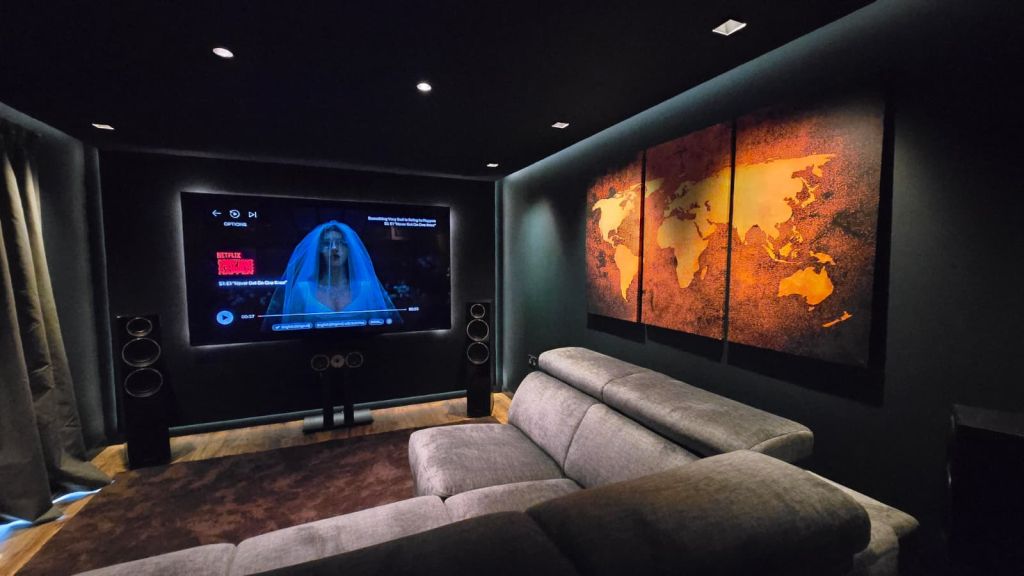
We delivered a complete garden-room cinema build in Gloucester — interior design, acoustic engineering, lighting design and control, installation, and in-room calibration. The client supplied the audio kit they already loved; our brief was to design the room that would let it perform at its best.
The result is a 7.1.2 Atmos cinema set inside a converted garden room, calibrated to deliver clear dialogue, controlled bass, and an enveloping surround field — all dressed in a finish that the family is happy to sit inside on an ordinary evening.
PROJECT AT A GLANCE
Location: Gloucester, UK (private residence)
Project type: Garden-room home cinema (client-supplied kit)
We managed: Interior design, acoustic treatment design, lighting design and integration, build (including floating front-wall feature), installation, calibration
Acoustics: Treatment effective from ~60Hz upwards; RT-60 textbook to 60Hz; >30cm of treatment in the front wall; 50–68mm in the ceiling
Audio layout: 7.1.2 Atmos — 3 front, 4 surround, 2 in-wall height channels in the front wall, 1 subwoofer (rear corner)
Screen: Sony 85″ TV (wall-mounted on a Future Automation flush bracket)
Lighting: Philips Hue (client-supplied), integrated into the room’s cinema scenes
Finishes: Petrol-green fabric walls, deep-blue ceiling, off-black skirtings
THE BRIEF
The client had already invested in a set of speakers and electronics they were attached to. What they did not yet have was a room engineered to let those components do their best work. Our job was to design the envelope — acoustically, visually, and operationally — so the existing kit performed beyond what it could in an ordinary square room.
ACOUSTIC ENGINEERING
Most rooms succeed or fail at the low end. We designed and installed acoustic treatment intended to remain effective down to approximately 60Hz, with the depth of treatment varying by surface to suit the geometry of a single-skin garden building:
- More than 30cm of broadband acoustic treatment in the front wall
- Between 50mm and 68mm in the ceiling (the maximum that the acoustic fabric run could conceal)
- RT-60 (the room’s reverberation profile) measured textbook from ~60Hz upwards after treatment
The result is a room that controls reflections without sounding “dead”, with bass that hits and stops cleanly rather than ringing on into the next line of dialogue.
LISTENING POSITION TUNING
Acoustic treatment fixes most of the room. The last six decibels are won at the seat. Using Dan’s own Dynaudio reference speakers to isolate the room’s contribution from the client’s speakers, we measured the listening position before and after a modest physical adjustment: moving the sofa back by approximately six inches. That one change took six decibels out of an 80Hz peak — a meaningful, measurable improvement in low-frequency response at exactly the seat the family actually uses. The waterfall plot speaks for itself.
THE FLOATING FRONT WALL
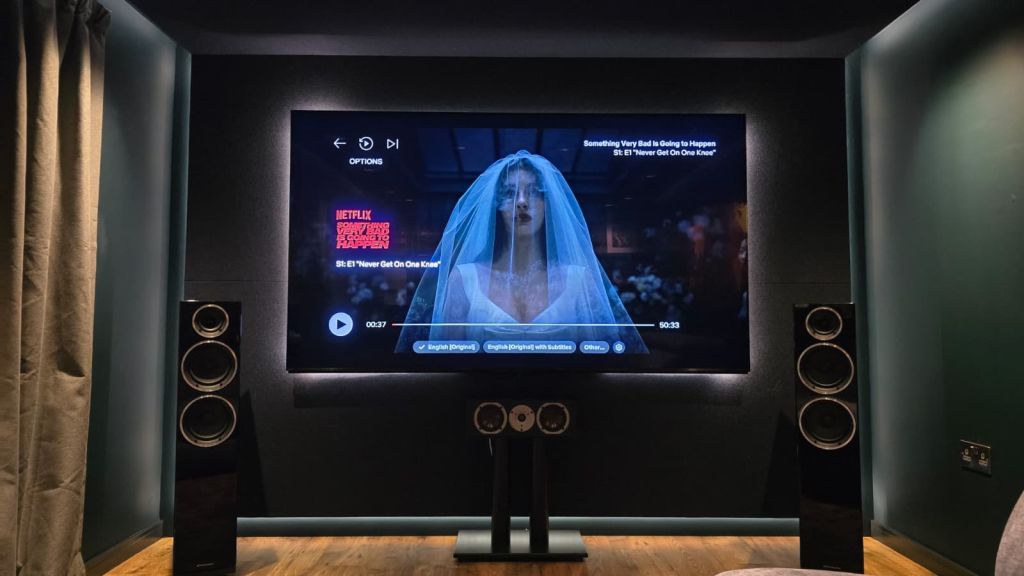
The room’s signature design feature is a floating front wall. LED tape runs continuously beneath the wall, up both vertical sides, and along the side walls — giving an unbroken band of light that visually lifts the entire front of the room off the floor and ceiling. With the curtains drawn and the lights down, the front wall reads as a single floating object holding the screen, with the rest of the room receding into soft darkness.
The Sony 85″ TV sits flush in the void in the front wall, hung on a Future Automation flush bracket. We specify Future Automation in part because their brackets hold their tolerance over the long term — we are still re-hanging FA brackets installed for clients more than two decades ago.
THE 7.1.2 ATMOS LAYOUT
The room is configured as a 7.1.2 Dolby Atmos cinema, using the client’s existing mix of Dali and Wharfedale speakers across the bed channels:
- Three front channels (left, centre, right) at screen height
- Four surround channels at ear height around the seating
- Two in-wall height channels installed inside the front wall — verified at the design stage as the right placement for the room’s geometry
- One REL subwoofer in the rear corner — modelled and confirmed as the right position for low-frequency performance at the seat
LIGHTING, INTERIOR AND PERSONAL TOUCHES
The room was designed to feel like a special place to spend time, with finishes chosen to absorb light rather than throw it back at the screen:
- Walls: a petrol-green fabric (close to a Farrow & Ball green but a shade more green) — the family’s choice, sourced by them
- Ceiling: deep blue
- Skirtings: off-black
- Smart lighting: client-supplied Philips Hue, integrated into the room’s cinema scenes — arrival, viewing, music, clean-up
- Coffee-table downlighters set discreetly into the ceiling
- Wall scallops at the foot of each side wall, revealed when the heading-wave curtains are drawn back
- Heading-wave curtains across the original garden-room door; smaller blackout curtains on the rear window
Personal touches on the back wall — three of the family’s favourite records framed, film posters, a Dolby badge — keep the room rooted in the household it belongs to.
SYSTEM SPECIFICATION
Video
- Display: Sony 85″ television (client-supplied), wall-mounted on a Future Automation flush bracket
- Bias lighting installed behind the screen for comfortable long viewing
Processing and amplification
- Marantz AV receiver with Audyssey room correction (client-supplied)
Speakers
- Bed channels: client’s existing mixture of Dali and Wharfedale speakers across the 7.1 layout
- Height channels: two in-wall speakers built into the front wall
- Subwoofer: REL, positioned in the rear corner
Acoustic and finish
- Front wall: >30cm broadband treatment behind acoustically transparent fabric
- Ceiling: 50–68mm treatment within the available depth
- Floating front-wall LED feature with continuous tape run
WHAT’S NEXT
A return visit is scheduled to complete Audyssey calibration on the Marantz processor and to take a fresh round of REW measurements once the room has fully settled. We will publish the post-calibration waterfall and frequency response alongside this case study when the work is complete.
FAQ
Can a garden room be a serious home cinema?
Yes — with the right acoustic design. The challenge of a single-skin garden building is bass control; the solution is depth of treatment in the right places, and a listening position tuned to the room rather than to the wall it happens to sit closest to. The result here is a 7.1.2 Atmos system that performs to a textbook RT-60 profile down to 60Hz.
Will Hidden Home Technology install client-supplied kit?
When the client has invested in components they already love and the components are well-matched to the brief, yes. Our value on a project like this lives in the room around the kit — acoustics, interior, lighting, calibration, and the design decisions that turn a collection of components into a coherent listening environment.
Why specify a Future Automation bracket for the TV?
Future Automation brackets hold their mechanical tolerance over the long term — we are still re-hanging brackets we installed more than twenty years ago. On a feature wall where the TV needs to sit flush and stay flush for the lifetime of the room, that long-tolerance behaviour matters more than the upfront cost difference.
NEXT STEPS
If you are planning a dedicated home cinema (or want to upgrade an existing room), we can manage the full journey: concept and interior design, manufacture and build, acoustics, lighting and control integration, AV installation, and final calibration.