The short answer, in 2026: for most new whole-house audio installations we recommend Bluesound. In our side-by-side listening we prefer the sound of its amplified products, and the BluOS platform sits more naturally inside a custom-installed control system. Sonos is still the right call for a household already invested in Sonos that needs another zone. The rest of this article is the reasoning: where each platform wins, what the app history means in practice, and what we would actually build for you.
Where Sonos became the default, and what it still does well
For most of the last decade, Sonos was the answer. There was no other answer. It was the first multi-room platform that simply worked. Drop a Play:5 into a room, tap an icon, music plays. By the time the competition caught up, Sonos had built the retail muscle. They had the brand recognition. They had the app familiarity. That made Sonos the safe choice for any builder, electrician or smart-home installer who needed a safe pick.
That status quo is still worth noting. Sonos really is easy. The hardware is robust. Replacement units are off the shelf, anywhere in the country. The app has had a difficult two years since the May 2024 relaunch. Basic Android notification-shade playback controls were only restored in March 2026. Sonos has another opt-in app overhaul in preview as of February 2026. The current user experience should be checked against the latest app version before any recommendation. For a household that already has six Sonos zones, knows how to use them, and just wants a seventh in the new garden room, Sonos may still be the right answer. (We’ll come back to this.)
Where Bluesound earns its place
Bluesound is part of Lenbrook International. They’re the Canadian group behind NAD Electronics and PSB Speakers. The BluOS multi-room platform is also a Lenbrook property. Bluesound launched in 2013. It set itself up against Sonos on three fronts that mattered. Over the past decade it has made a strong technical case on all three.
Sound quality is a clear step ahead in the right systems. In our installs, Bluesound’s amplified products have always given us better results than the closest Sonos equivalents. That judgement is based on real rooms. We put a Bluesound POWERNODE and a Sonos Amp side-by-side, driving the same speakers, before the client chooses. HybridDigital amplification applies to Bluesound’s amplified products such as the POWERNODE. It does not apply to every product in the range.
The user experience holds up. BluOS is Bluesound’s multi-room operating system. It’s a capable, installer-friendly platform. In our experience it has been dependable in whole-home systems. Sonos owners who lived through the S1/S2 transition in 2020, or the May 2024 app relaunch, will understand why software continuity matters.
It doesn’t lock the customer inside a single closed ecosystem. This is the front that matters most for the kind of system we build. It deserves its own section.
The URC fit: why “no app-switching” matters
Bluesound exposes a developer API. In practical terms, that means our URC Total Control system can expose BluOS music control end-to-end inside Total Control. URC is the control platform we use on every Hidden Home Technology integrated project. The fit covers Tidal, Qobuz, Spotify and Deezer browsing. It covers NAS and local-library navigation. It covers favourites, search, context menus, grouping, two-way metadata and full transport control. All of that comes via the URC BluOS Two-Way Module published in the URC Dealer Portal.
The aim is simple. Less app-switching. Less reaching for a separate phone. Fewer handsets on the coffee table. The control system that already runs the house can also run the music. The interface is designed around the way that particular household uses the system.
Across the centralised-rack installs we’ve done over the last several years, clients always report the same thing. The “no app-switching” benefit is the moment the system clicks. Once the URC interface they already use for lighting, AV and climate also runs the music, the phone stays in the pocket. We’ve heard variants of that feedback enough times across enough households to call it the pattern, not the exception. It’s the kind of benefit you only see in a long-tenure install, not in a thirty-day product review.
The Roon angle: what Roon Ready actually means
Bluesound’s current players are Roon Ready. That includes the current-generation NODE, POWERNODE, POWERNODE EDGE, VAULT and NODE ICON. It also includes the legacy 2i family (NODE 2i, POWERNODE 2i, PULSE MINI 2i, PULSE FLEX 2i). Those became Roon Ready via firmware in the 2021 rollout. For households running Roon Server, that means bit-perfect endpoint control, multi-zone synchronisation and DSP across compatible Bluesound devices. They sit alongside other Roon Ready hardware in the system.
Roon is a separate piece of music-management software. It sits above your library, your streaming services and your hardware. It treats the whole lot as one navigable thing. The interface is designed for people who care about what they’re listening to. That means credits, recordings, similar artists, and the connections between musicians, producers and records. For households that take music seriously, it’s often the right top layer.
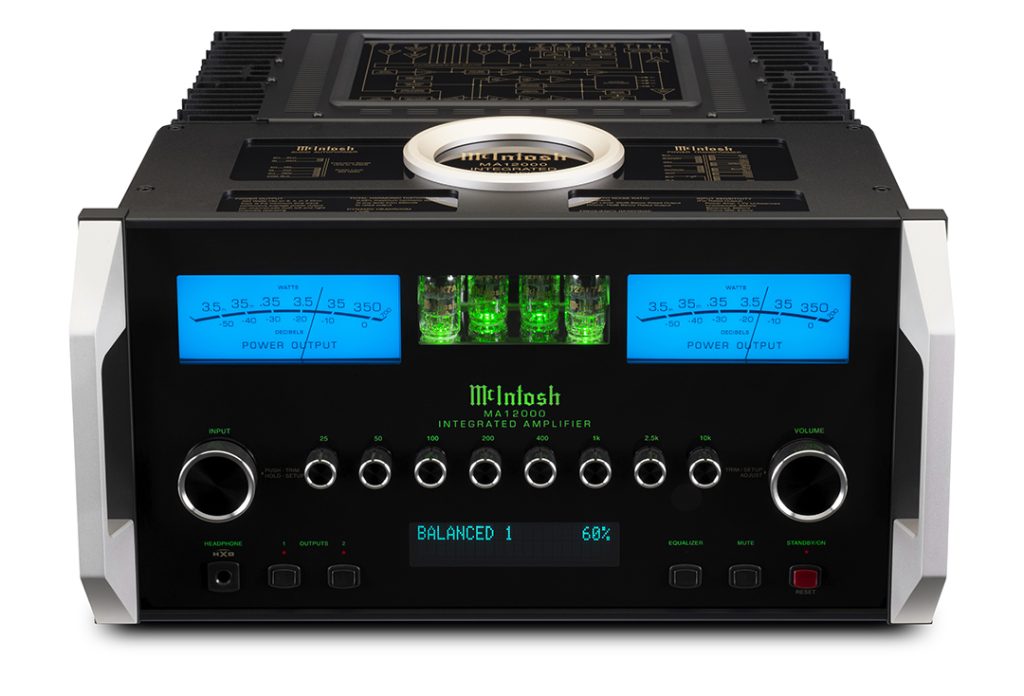
The detail matters here. McIntosh products are typically specified as part of a wider Roon architecture rather than assumed to be Roon Ready endpoints. McIntosh’s position is mostly Roon Tested. The C49, C53, C2700, C2800 preamps and similar are Tested rather than Ready. A few specific Roon Ready streaming products like the MSA5500 do exist. In our systems they are usually fed by a separate Roon Ready streamer or server. The Grimm Audio MU2 is fully Roon Ready as of the November 2025 firmware. It shows up in the Roon app with its own identity and dB-scaled volume control. The Mola Mola Tambaqui is Roon Ready over its built-in Ethernet input. Innuos products span Roon Core servers (ZENith Next-Gen, Statement Next-Gen, Stream) and Roon Bridge endpoints (the Pulse range). The architectural role depends on the model chosen.
That leads to the architecture we now recommend most often.
The mixed-ecosystem upgrade path most reviews don’t cover
This is the differentiator that doesn’t appear in most magazine comparisons. Reviewers are usually comparing boxes. They’re not designing the long-term infrastructure of a house.
BluOS in the secondary zones — kitchen, bedrooms, bathrooms, garden, study. Bluesound POWERNODE units drive existing passive speakers in those rooms. PULSE MINI 2i or PULSE FLEX 2i go where a one-piece unit is the right call. Both are Roon Ready. They integrate cleanly with a Roon server elsewhere in the system.
Roon endpoints in the primary zone or two. This is the listening room. The dedicated cinema. The main living space where the household actually sits down and listens. Here we specify the Roon architecture that does the source justice. Examples include a Grimm Audio MU2, a Mola Mola Tambaqui fed by an Innuos ZENith Next-Gen, or a McIntosh system fed by an MSA5500 or a separate Roon Ready streamer.
The whole house can run from one Roon Server where Roon is part of the brief. The whole house can be controlled from URC Total Control where the project calls for all-in-one control. Each zone sounds right for what that zone is for. The kitchen doesn’t need a £15,000 streamer. The listening room shouldn’t be served by a £400 one. With this architecture you get both, cleanly. There’s no cost penalty for buying high-end hardware for every zone. There’s also no sound-quality penalty for running the listening room on a basic multi-room streamer.
This is what we now build by default for households where streaming is the primary source. It’s the answer to the question that Sonos, pure-Bluesound and pure-Roon systems each only partially answer.
When Sonos still wins
Honest section. There are still cases where Sonos is the sensible answer.
You’re heavily invested in Sonos already and you want to add a zone. The kit you have works. The household knows the app. You just need another speaker in the new orangery. Add the Sonos. It will integrate with what you have. Everyone in the household can keep using the interface they already know. The marginal cost of staying inside Sonos is lower than the cost of migrating.
Sonos can also make sense for simple TV/soundbar rooms. It can work for budget-conscious wireless zones. It fits rental properties, households with no control-system requirement, voice-assistant-led rooms, or clients who simply prioritise retail simplicity over deeper fit.
In other scenarios, there is usually a better answer. That includes new build, partial replacement, a system that has outgrown what Sonos can do, or a house that needs music to integrate cleanly with lighting, AV, climate and control.
When your Sonos is stuck on S1: the migration recommendation
The Sonos owners we hear from most are the ones running older kit on S1 software. Several first-generation Sonos products are locked to the S1 controller and cannot be updated to S2. The list includes the original ZonePlayers (ZP80, ZP90, ZP100, ZP120). It also includes the Connect and Connect:Amp sold between 2006 and 2015. The Play:5 Gen 1, the CR200 controller and the Bridge are also locked to S1. Households running any of these on the same network as newer Sonos kit have to keep the whole system on S1. There is no part-upgrade path. Not every ten-year-old Sonos product is S1-locked. The first step is always to identify the exact models in the house.
The category we see most often is the centralised five-room rack from five to ten years ago. It was originally specified around Sonos because Sonos was the only credible multi-room option at the time. The Sonos API of that era was constrained. Basic play, pause, group and track-skip worked. Deeper two-way fit with control systems was limited. Today we replace those Sonos boxes with Bluesound POWERNODES driving the same speakers. Same wiring. Same speakers. Dramatically better source and full URC fit. It’s not always cheaper than buying new Sonos kit. But it’s almost always the right move when the original install is reaching the end of its useful life. Same applies if the household has invested in a control system the older Sonos can’t fully integrate with.
Our recommended migration path:
- Audit what you’ve got. Which players still work, which are S1-locked, which zones use passive speakers, and which rooms are better served by a one-piece wireless speaker.
- Where Sonos is currently driving passive speakers, replace the Sonos amplifier/streamer with a Bluesound POWERNODE. Where the zone uses a true all-in-one speaker, replace the unit with a PULSE MINI 2i, PULSE FLEX 2i or redesign the zone.
- In the primary listening room or rooms, step up to the right Roon architecture. That could be a Grimm Audio MU2, a Mola Mola Tambaqui with an Innuos ZENith Next-Gen server, or a McIntosh system fed by an MSA5500 or a separate Roon Ready streamer.
- Bring the lot under URC Total Control where the house already has lighting and AV fit. The BluOS Two-Way Module gives you full music control inside the same interface as the rest of the house.
The result is a household where each zone sounds right for what it does. The control system is consistent across it. The upgrade path going forward is open rather than tied to one manufacturer’s roadmap.
What we’d build for you
A sample system for a four-bedroom Bath townhouse with a dedicated listening room or media room:
- Listening room: Grimm Audio MU2, or Mola Mola Tambaqui fed by an Innuos ZENith Next-Gen. Into an right amplifier from McIntosh, Gryphon or Mola Mola. Into suitable floor-standers from Bowers & Wilkins, Sonus Faber or Marten.
- Living room: Bluesound POWERNODE driving in-wall or freestanding speakers. Roon Ready, so it integrates straight into the same Roon server as the listening room.
- Kitchen, study, bedrooms: PULSE MINI 2i or PULSE FLEX 2i depending on the room. Both are Roon Ready.
- Garden room: Bluesound POWERNODE driving outdoor-rated speakers.
- Roon Server: Innuos ZENith Next-Gen as the standard recommendation. Roon Nucleus as an alternative. Headless Mac mini in the rack as a budget fallback.
- Control: URC Total Control with a single interface across music, lighting, AV and climate.
Indicative budget for systems of this type typically starts in the mid-five figures. It rises with the primary-room electronics and speakers. We’d talk through what’s right for your house before specifying anything in detail.
Multi-room audio rarely travels alone: most of these systems land as part of a wider smart home and home automation installation — lighting, blinds, AV and climate on the same single interface.
If you’re looking for the short rule of thumb we use when scoping a job: for a household with no existing audio system, we default to Bluesound unless there’s a specific reason to pick Sonos. For a household already invested in Sonos and just wanting to add a zone, Sonos. For households where streaming is the primary source and there’s serious listening intent, we go mixed. That means a dedicated room or a primary system worth specifying around. Bluesound in the secondary zones. Roon endpoints in the primary. Grimm Audio, Mola Mola, Innuos or McIntosh hardware on the source side depending on budget and taste.
Book a Bath listening room appointment
Our listening room in Bath has the architecture above set up end-to-end. Bluesound in the secondary zones, Roon Server, and a primary-room system tuned for serious listening. You’re welcome to bring your own music and your own questions.