Bluesound
Bluesound launched in 2013 as the original hi-res multi-room music brand, created with one clear ambition: to let you play your favourite music beautifully in every room of the home. It draws on serious audio heritage as part of a Canadian family of respected audio companies, inheriting amplifier and loudspeaker know-how that gives Bluesound genuine audiophile credentials rather than mere convenience. At the heart of the range sits BluOS, an operating system that streams lossless and high-resolution music across your network with unusual stability.
Why we carry Bluesound
We have been installing whole-home audio for over twenty-five years, which is long enough to have installed most of the systems that came before this one — and long enough to know that the failure mode of multi-room audio is never the sound quality. It is the support call eighteen months later.
Bluesound is the platform we reach for when a client wants proper hi-res audio in more than one room and does not want a rack of separates in every one of them. Three things earn it that place.
It is one platform, not a family of loosely related products. A Node in the study, a Powernode in the kitchen and a Pulse in the bedroom appear in the same app, group together, and stay in step. That sounds obvious. It is not — a great deal of multi-room kit does not manage it.
It is genuinely lossless. BluOS handles high-resolution and lossless sources natively rather than transcoding everything down to something convenient. If you pay for a hi-res subscription, you hear what you paid for. It also works as a Roon endpoint, which matters to a particular kind of client, and integrates with the main streaming services and with local network storage.
It updates without breaking. We have Bluesound installations that have been running for years and have taken firmware updates the whole way without a site visit. From an installer’s point of view that is the single most valuable property a product can have, and it is why we will happily put our name to it.
We wrote about how it compares to the obvious alternative at length: Bluesound vs Sonos, a custom installer’s view after two decades of installing whole-home audio.
The range, and what each box is for
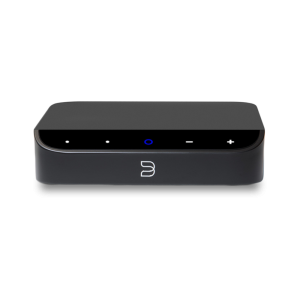
NODE NANO — around £349. The smallest streamer in the range. Adds BluOS to an amplifier you already own, in a box small enough to hide behind it.
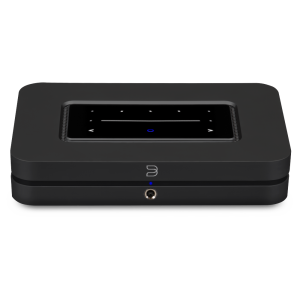
NODE — around £499. The workhorse streaming source. The one to buy if you have an amplifier and speakers you like and simply want a better front end for them.
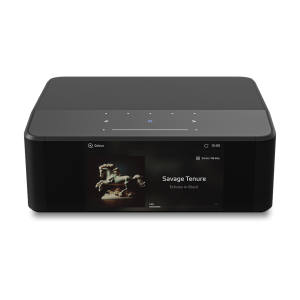
NODE ICON — around £999. The reference streamer of the range, with a proper display and a more ambitious analogue output stage. This is the model that will still satisfy when the rest of the system gets upgraded around it.
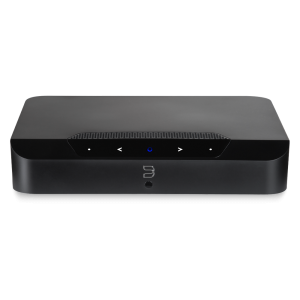
POWERNODE EDGE — around £649. Streamer and amplifier in one, sized for a smaller room and a sensible pair of speakers. Our default recommendation for a kitchen, a home office or a guest room.
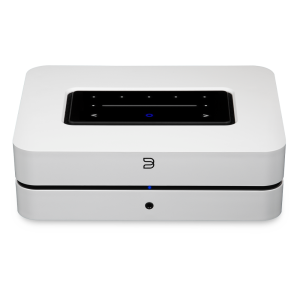
POWERNODE — around £899. The full-size streaming amplifier: enough power for real loudspeakers in a real room, small enough to live inside a cabinet. Probably the single most-specified box in the whole Bluesound catalogue, and deservedly so.
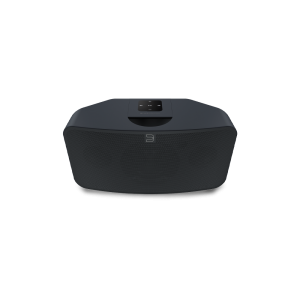
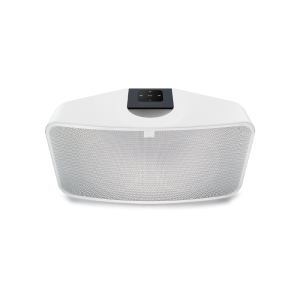
PULSE MINI — around £649 and PULSE — around £749. One-piece wireless speakers for rooms where separate speakers are not wanted or not possible. Bedside, kitchen, garden room, dressing room.
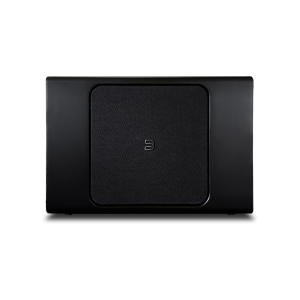
PULSE SUB+ — around £799. A slim wireless subwoofer that pairs with a Powernode or a Pulse. Worth adding in any room where the main speakers had to be small for aesthetic reasons — which, in practice, is most rooms.
How we actually specify it
Start from the rooms, not the boxes. Write down every room you want music in and be honest about which ones will actually get used. Most households over-specify two rooms and under-specify the kitchen.
Put the amplification where the speakers are. A Powernode in the room it serves is simpler, cheaper and more reliable than long speaker runs back to a central rack — unless you are building from bare walls, in which case centralising can be the better answer. This is the decision worth taking advice on before the plasterboard goes up.
Do not let the network be the weak link. The commonest cause of a multi-room system that “keeps dropping out” is not the streamer. It is domestic wi-fi being asked to do a job it was never designed for. Wherever we can, we run Bluesound units on wired ethernet, and where we cannot we fix the wireless network properly first. If your existing system is unreliable, this is almost certainly why.
Match the speakers to the room, not to the amplifier’s specification. A Powernode driving a well-chosen small pair of loudspeakers in a kitchen will sound better than the same box straining to drive something ambitious. See also our wireless and multi-room speakers.
Plan for the television. A Powernode with the TV connected to it replaces a soundbar and doubles as the music system. It is one of the easiest upgrades in the range to justify, and it is routinely forgotten at the planning stage.
Where it fits alongside the rest of the house
Bluesound handles music. It does not handle lighting, blinds, heating or cinema, and we would not pretend otherwise. Where a client wants one interface across all of it, we design the wider system around a proper control platform — see multi-room AV and smart home automation — with BluOS doing the audio distribution underneath. For an example of that approach in a finished house, see our whole-home audio and smart control project in Englefield Green, Surrey.
Hear it
Hidden Home Technology supplies, installs and configures the full Bluesound range from our base in Bath, Somerset. We are a family-run, CEDIA Professional Member business, working across Bath, Bristol, the Cotswolds, the wider South West, South Wales, London and the Home Counties.
Where can I buy Bluesound in the UK?
Through Hidden Home Technology in Bath. We carry the NODE, NODE NANO, NODE ICON, POWERNODE, POWERNODE EDGE, PULSE, PULSE MINI and PULSE SUB+, and we install and configure them properly rather than leaving you with a box and an app. Get in touch.
What is the difference between a NODE and a POWERNODE?
The NODE is a streamer only — it needs an amplifier. The POWERNODE is a streamer with the amplifier built in, so it drives a pair of passive speakers directly. If you already own an amplifier you like, buy a NODE. If you are starting a room from scratch, buy a POWERNODE.
Can Bluesound work with my existing hi-fi?
Yes. That is exactly what the NODE range is for: it adds BluOS streaming to an amplifier you already own and keep. Tell us what you have and we will tell you which model to add — and whether it is worth going straight to the NODE ICON.
Showing all 10 resultsSorted by price: low to high
-

Bluesound PULSE FLEX
Wireless & Multi-Room Speakers
£299.00 -
Bluesound NODE NANO
Streamers
£349.00 -
Bluesound PULSE M
Wireless & Multi-Room Speakers
£479.00 -
Bluesound NODE
Streamers
£499.00 -
Bluesound POWERNODE EDGE
Integrated Amplifiers
£649.00 -
Bluesound PULSE MINI
Wireless & Multi-Room Speakers
£649.00 -
Bluesound PULSE
Wireless & Multi-Room Speakers
£749.00 -
Bluesound PULSE SUB+
Subwoofers
£799.00 -
Bluesound POWERNODE
Integrated Amplifiers
£899.00 -
Bluesound NODE ICON
Streamers
£999.00