
Loudspeakers
Steinway & Sons Model D
POA
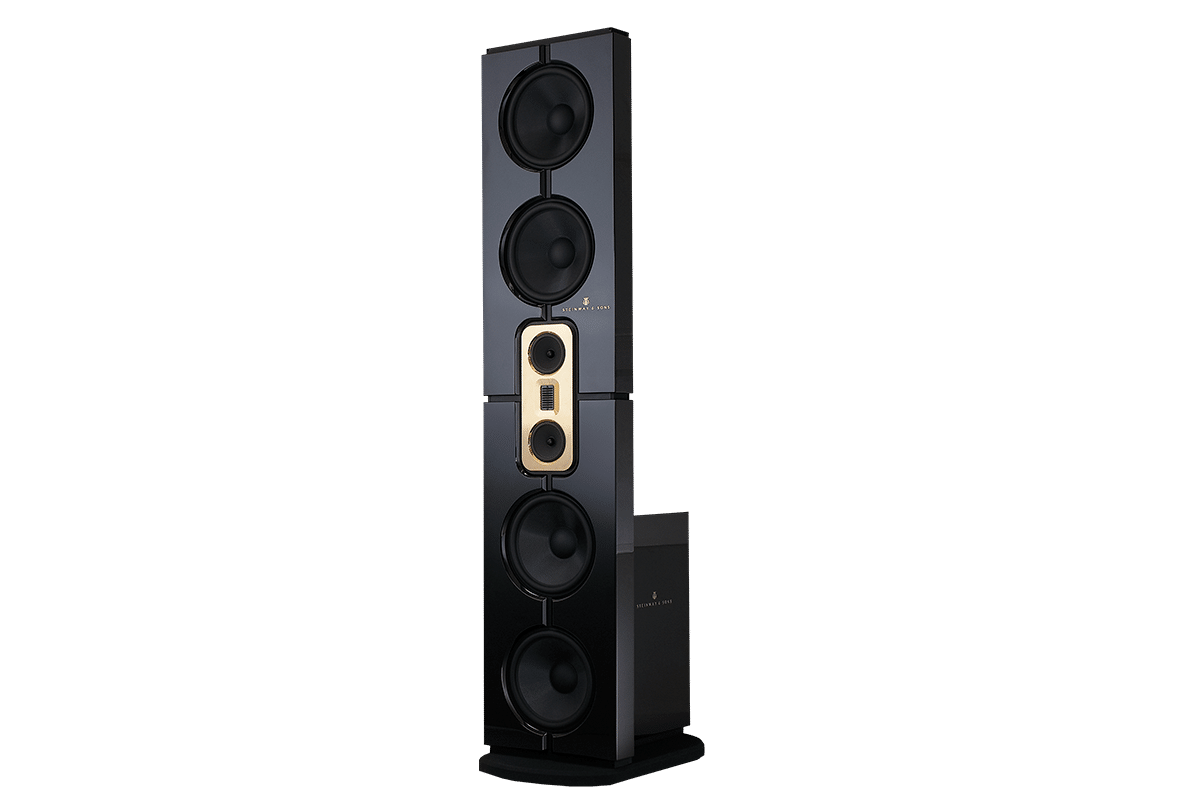
The largest Steinway & Sons loudspeaker: a full-range open-baffle dipole with four woofers, two midranges and an Air Motion Transformer tweeter.
Description
Description
Overview
The Model D was the first Steinway & Sons loudspeaker and it remains the largest the company builds. It laid the foundation for everything Steinway Lyngdorf has done since. It is a full-range floor-standing dipole, which means it radiates sound from the back as well as the front and is not enclosed in a cabinet at all. Four extra-large woofers, two midrange drivers and an ultra-light Air Motion Transformer tweeter are mounted in an open aluminium frame. It reaches from 20 Hz to 22 kHz and will produce 117 dB at a metre. Each loudspeaker weighs 174 kg.
Design & build
The baffle is milled from solid blocks of aluminium, with more than 170 hours of precision machining going into each loudspeaker. The result is a frame rigid enough to hold four large woofers without contributing anything of its own. There is no sealed box, so the drivers never work against a column of compressed air, and none of the colourations of a cabinet arrive with the music. The standard finish is high-gloss black with gold or chrome accents, and custom finishes are available. Dimensions are 205.8 by 46.4 by 79.7 cm, and the loudspeaker is designed to stand clear of walls.
Sound & performance
The dipole arrangement does something a conventional box cannot. Because the bass radiates equally forwards and backwards, the energy cancels acoustically at the sides, which markedly reduces the reflections coming off the sidewalls of the room. What you hear is more of the loudspeaker and less of the room around it. Frequency range runs from 20 Hz to 22 kHz, so nothing is missing at either end, and maximum sound pressure is 117 dB measured at one metre. The Air Motion Transformer tweeter is very light and very fast, which is what gives the top end its unforced quality at high levels.
Key features
- Full-range dipole: four extra-large woofers, two midranges and an Air Motion Transformer tweeter, with no enclosure.
- Baffle milled from solid aluminium, over 170 hours of machining per loudspeaker.
- Frequency range 20 Hz to 22 kHz; 117 dB maximum SPL at one metre.
- Requires two amplification channels per loudspeaker, from an A1 or A2 at 2 × 400 W.
- Requires a Steinway Lyngdorf processor as well as the amplifier; there is no passive, use-any-amplifier version.
- Digital crossover held in the processor rather than in the loudspeaker.
- Neutrik speakON 4-pole connection; floor-standing, positioned clear of walls.
Technology
There is no crossover network inside the Model D. The filtering is digital and stored in the processor: the woofers are low-passed at 150 Hz with a fourth-order slope, the midrange is high-passed at 250 Hz second order, and the handover from midrange to tweeter happens at 2500 Hz, also second order. Each loudspeaker is driven by two amplification channels, the manufacturer describing a combined 800 W of amplification per speaker. Audio travels from processor to amplifier over the Steinway Lyngdorf Digital Link, a proprietary CAT 5e based interconnect rather than a network or an analogue cable, and from the amplifier to the loudspeaker on speaker cable terminated in Neutrik speakON.
Specifications
- Drivers: Air Motion Transformer tweeter, 2 × midrange, 4 × extra-large woofers, open dipole aluminium baffle
- Amplification: 2 channels per loudspeaker, from an A1 or A2, 2 × 400 W
- Other: 20 Hz to 22 kHz; 117 dB maximum SPL at 1 m; digital crossover held in the processor; Neutrik speakON 4-pole; 205.8 × 46.4 × 79.7 cm; 174.0 kg each; high-gloss black with gold or chrome accents
Who it’s for
This is a loudspeaker for a large, properly considered room and an owner who wants the reference rather than an approximation of it. It is full-range on its own, so no separate boundary woofers are needed. What is needed is the rest of the system: a Steinway Lyngdorf processor and A1 or A2 amplification, two channels for every loudspeaker. At 174 kg each and over two metres tall, the Model D also has practical implications for floor loading, access and delivery that are far better resolved on a drawing than on the day.
Why buy from Hidden Home Technology
A pair of Model D deserves a room designed around them, and that is the work we do. Hidden Home Technology is a CEDIA member based in Bath, designing and installing systems at this level from first drawings through to final calibration. We can arrange a demonstration so you hear what the dipole approach actually does, then plan placement, amplification, cabling and access properly before a single crate arrives.
Reviews (0)
You must be logged in to post a review.
Reviews
There are no reviews yet.