Streamers
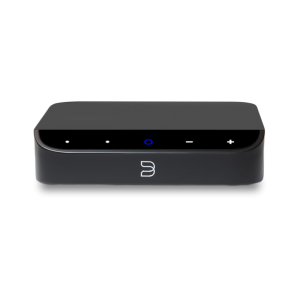
Bluesound NODE
£549.00
The Bluesound Node is the do-it-all BluOS streamer — ESS Sabre DAC, HDMI eARC for the TV, a built-in THX-AAA headphone amplifier and Dirac Live readiness. The compact streamer most BluOS owners actually want.
Description
Description
The middle of the Bluesound range, refined
The current Bluesound Node (N132) sits between the entry-level Node Nano and the flagship Node Icon. It’s the streamer most BluOS-curious customers actually want. Proper hi-fi connectivity. A respectable DAC. The right features (HDMI eARC, Dirac Live, THX-AAA headphone amp, 12V trigger). All in a half-width chassis that’s easy to slot in next to an existing amp.
Where it fits
The Node is the right pick when you want one streamer that handles everything. TV sound, hi-res streaming, headphones, optional room correction. It feeds into an existing integrated amplifier or active monitors. Common pairings: a Naim Nait XS, a Hegel H190, a McIntosh MA252, or a pair of active KEF LS50 Wireless II or PMC Result6 monitors.
ESS Sabre DAC
The Node uses the same ES9039Q2M Sabre DAC chip that runs (in dual-mono) inside the flagship Node Icon. Native playback handles up to 24-bit/192 kHz. DSD256 and MQA pass through BluOS cleanly.
HDMI eARC
Plug the Node into the TV via HDMI eARC. You get a clean, single-cable TV-sound source for whichever amplifier or active speakers the Node feeds. CEC volume control via the TV remote works on most modern TVs.
THX-AAA headphone amplifier
A 6.35mm headphone jack on the front. It’s driven by a THX-AAA-built amp. Properly engineered, low-distortion headphone listening straight from the streamer. No separate headphone amp needed for a daily-use rig.
Dirac Live ready
The Node is Dirac Live Ready out of the box. With the optional calibration kit (or one of ours on a custom install) you measure the actual room. The Node then corrects in the digital domain. It evens out bass humps, suckouts and reflections. A real listening-room benefit that doesn’t appear on most streamers in this category.
BluOS multi-room
Same BluOS platform across every Bluesound product, the multi-room system we rate above Sonos for a serious whole-home setup. The Node is Roon Ready too. Drop it into an existing Roon Server as a high-quality endpoint.
See the Full specifications list below for the complete spec sheet.
Full specifications
- Model: Bluesound Node (N132)
- DAC: ESS ES9039Q2M Sabre
- Native playback: up to 24-bit/192 kHz · DSD256 + MQA supported
- HDMI: eARC with CEC
- Other digital inputs: Toslink optical / 3.5mm combo, coaxial RCA, USB-A (external storage)
- Analog outputs: RCA stereo (fixed level), RCA subwoofer pre-out (or wireless to PULSE SUB+)
- Digital outputs: Coaxial RCA, Toslink optical, USB Audio 2.0
- Headphone: 6.35mm front jack (THX-AAA)
- Room correction: Dirac Live Ready (calibration kit sold separately)
- Roon: Roon Ready
- Streaming services: Tidal Connect, Qobuz, Spotify Connect, Amazon Music HD, AirPlay 2
- Bluetooth: 5.2 with aptX Adaptive (two-way)
- Network: Gigabit Ethernet, dual-band Wi-Fi 5
- Custom-install control: 3.5mm IR input, 12V trigger output
- Dimensions: 220 × 46 × 146 mm (W × H × D)
- Weight: 1.09 kg
- Finish: matte satin paint, black or white
Order from Hidden Home Technology
Authorised Bluesound dealer in Bath. Free UK delivery. Custom-install advice on tap.
The wider view: Bluesound NODE reviews in brief
We used a Bluesound NODE at a period house in the Cotswolds, where it feeds the speakers hidden in the garden. POWERNODE amplifiers drive the invisible speakers in its drawing room and kitchen. They all run on BluOS, which is the multi-room system we rate above Sonos for a serious whole-home setup.
On its own the NODE is a small streamer that also takes the sound from a television and has a headphone socket on the front. What Hi-Fi? reviewed it in November 2024 and called it “admirably controlled, balanced and easygoing”. In July 2026 eCoustics found it clearer and tighter than the model it replaces and called BluOS stable and mature. A BluOS owner of more than ten years posted measurements of the NODE on the Audio Science Review forum in February 2025. They found its performance good enough, short of the best, and the system “very pleasant and easy to use”.
It is worth knowing that What Hi-Fi? gave it four stars out of five and preferred a rival streamer at the same price for drama and drive. HiFi Pig also wanted a little more energy in the sound.
So the NODE suits someone who wants one tidy box feeding an amplifier they already own, or the first room of a system that will grow. Where a room needs its own amplifier the POWERNODE does the same job with one built in. Call us and we will help you plan the rooms.
Sources: What Hi-Fi?, “Bluesound Node (2024) review”, 25 November 2024. eCoustics, “Bluesound NODE Review”, July 2026. Audio Science Review forum, “Bluesound Node N132 Streamer review” by a member, 25 February 2025. HiFi Pig, “Bluesound NODE 2024 Streamer”, 15 February 2025. Our Cotswolds project page.
Read what the critics say about more of our streamers in The Hi-Fi Review Bible.
Press & reviews
Specification
Black or White: Matte Satin Paint
Product Dimensions:
220 x 46 x 146 mm (W x H x D)
8.7 x 1.8 x 5.7 in (W x H x D)*
*Non-metric measurements are approximate.
Included Accessories:
• 120V AC Power Cord
• 230V AC Power Cord
• Stereo RCA to RCA Cable
• Ethernet Cable
• Mini Jack to Toslink Adapter
• Safety/Warranty Guide
• Quick Setup Guide
• Dirac Live Ready Info Card
Storage Environment:
-10°C to 50°C, 20% to 80% relative humidity
Product Weight:
1.09kg/2.4lb
Operating Environment:
0°C to 40°C
Power Supply:
Universal bi-pin AC cord input (100-240AC)
Optical/Analog Input:
Combo - Mini TOSLINK/Stereo 3.5mm
Coaxial Output:
RCA
Ethernet/LAN:
Ethernet RJ45, Gigabit 1000 Mbps
IR Input:
3.5mm Jack
Optical Output:
TOSLINK digital optical
Wi-Fi Built In:
Wi-Fi 5 (802.11ac), dual-band
HDMI Input:
HDMI eARC
Trigger Out:
12 Volt
Bluetooth Quality:
Bluetooth 5.2 aptX Adaptive
USB IN:
Type A (Fat32 Formatted) - External Storage only; Local Server Mode
Headphone Output:
6.3mm Stereo; Bluetooth
Bluetooth Connectivity:
Two-Way (transmit & receive)
Audio Output:
Analog RCA Stereo with Fixed option; USB Audio 2.0 (Type A)
Subwoofer Output:
RCA x 1; Wireless to PULSE SUB+
IR Optical Built In:
IR Sensor Built In - front panel with IR Remote Learning
Supported Audio File Formats:
MP3, AAC, WMA, WMA-L, OGG, ALAC, OPUS
Native Sampling Rates:
up to 192 kHz
Signal-to-Noise Ratio:
-118 dB
Supported High-Quality Audio File Formats:
FLAC, MQA, WAV, AIFF, MPEG-4 SLS
Bit Depth:
16-24
Distortion:
THD+N, 0.0007%
DSD Support:
DSD256
Audio Controls & EQ:
BluOS Controller App
Headphone Continuous Output Power (THD<0.1%):
160mW, 16Ω
230mW, 32Ω
53mW, 250Ω
22mW, 600Ω
Supported Multi-Channel Audio Formats:
Dolby Digital®
DAC:
ESS ES9039Q2M
Dirac Live Output Support:
Analog: RCA Stereo
Digital: Optical, Coaxial
The USB Output does not support Dirac Live
Operating System:
BluOS
Supported Network File Sharing:
Server Message Block (SMB) up to 200,000 files
3rd-Party Integrations:
AirPlay 2, Spotify Connect, Tidal Connect, Roon Ready, Dirac Live Ready
App Controller Operating System:
iOS, Android, Windows, macOS
Album Art Supported:
JPG, PNG
Control System Integrations:
Crestron, Control4, RTI, ELAN, URC, Lutron
Processor
ARM® Cortex™ -A53, Quad-Core, 1.8GHz per core
Music Services & Internet Radio:
23+
Music Services
Internet Radio
Voice Control Integrations:
Amazon Alexa Skills
Status Indicator:
LED x 2
Volume Control Buttons:
Touch Slider LED
Proximity Sensor:
Yes
Play/Pause Button:
Touch LED
Preset Buttons:
Touch LED x 5