Most domestic loudspeakers don’t horn-load anything above the bass. Almost every speaker on every hi-fi shelf in the UK uses a direct-radiating dome tweeter sitting in a flat baffle — sometimes with a small waveguide moulded around it, more often without. The reasons are partly historical and partly cosmetic. Horns have a reputation, deserved or not, for sounding “shouty”; horns are also large, and large is harder to sell into a domestic room than small.
Ø Audio, the Norwegian loudspeaker company we have just brought onto our hi-fi shelf, do something different. The Frigg 02 horn-loads the tweeter through a small DXT waveguide; the Icon 12, Verdande and Ymir horn-load everything above the bass through Ø Audio’s own Q.V.S.T. — Quad Vertex Soundfield Technology — waveguide. This article is a short explanation of what Q.V.S.T. is, why horn-loading the midrange and treble matters in a real listening room, and what Ø Audio have actually engineered.
What horn-loading does
A horn is, in the simplest terms, an acoustic impedance matcher. A compression driver — a small diaphragm in a sealed chamber — couples poorly to the open air directly. Connect it to a horn, and the horn gradually expands the cross-sectional area of the wavefront from the driver to the room, matching the high acoustic impedance at the driver to the low acoustic impedance of the room. The result is dramatic: a horn-loaded driver can produce the same sound pressure level as a direct-radiating driver with a fraction of the electrical input. That is what is meant by efficiency. A 92 dB sensitivity loudspeaker — the Icon 12 figure — will play 6 dB louder than an 86 dB loudspeaker on the same amplifier, and it will do so with the driver moving less, which means less distortion.
The second thing a horn does, properly designed, is control directivity. A direct-radiating dome tweeter beams the highest frequencies straight forward; the further off-axis you sit, the duller the top end gets. A horn, by contrast, can be shaped so that the angular pattern of the radiation stays roughly constant with frequency — what acousticians call constant directivity. The off-axis sound has the same tonal balance as the on-axis sound, which means the reverberant field in the room — the part of the sound that bounces off walls and ceiling — has the same colour as the direct sound. That is the engineering reason why a well-implemented horn images more stably across listening positions than a direct radiator.
Why most speakers don’t do it
If horns are more efficient and image more stably, why isn’t every loudspeaker horn-loaded? Two reasons. The first is the historic resonance problem. Early horns — and many later ones — had clearly audible cabinet-and-throat resonances, which gave them a hard, forward, “shouty” quality on dense material. The second is geometry. To control directivity down through the midrange, a horn needs to be physically large at the mouth — much larger than a typical bookshelf tweeter assembly. Most consumer loudspeakers can’t accommodate one and still look like furniture.
The first problem — resonance — is an engineering problem with a solution. The second problem — geometry — is a packaging problem with a trade-off: accept a larger speaker, or limit horn-loading to the top end only.
What Q.V.S.T. actually is
Q.V.S.T., or Quad Vertex Soundfield Technology, is Ø Audio’s answer to both problems. The “quad vertex” refers to the four-vertex geometry of the horn’s expansion. Conventional horns expand smoothly along a single profile — typically exponential, conical or tractrix. The Q.V.S.T. mouth is shaped by four discrete vertex points that together define the radiation pattern, which Ø Audio specify as a constant-directivity geometry across the design bandwidth. The intent is to hold the angular pattern stable from the upper midrange up through the highest frequencies the horn handles — a flat polar response across the operating band rather than the narrowing pattern that conventional waveguides exhibit as frequency rises.
The second engineering problem — the historic horn resonance signature — is addressed in two places. First, the horn profile itself is shaped to minimise the strong throat-and-mouth modes that gave older horns their characteristic colour. Second, the compression driver itself — a ¾-inch carbon-fibre diaphragm unit in the Icon 12 and Verdande — is chosen to break up more cleanly at the top of its bandwidth than conventional aluminium or titanium dome tops, which both ring at known frequencies.
The result, in listening, is the consistent observation across the editorial coverage of the range: the dynamic ease and efficiency of a horn-loaded speaker, without the tonal signature that historically came with it. Hifi Pig’s Editor’s Choice for the Icon 12, the StereoNET Applause Award, and Stereophile’s coverage of the Verdande, all land on the same point.
The Ø Audio implementation across the range
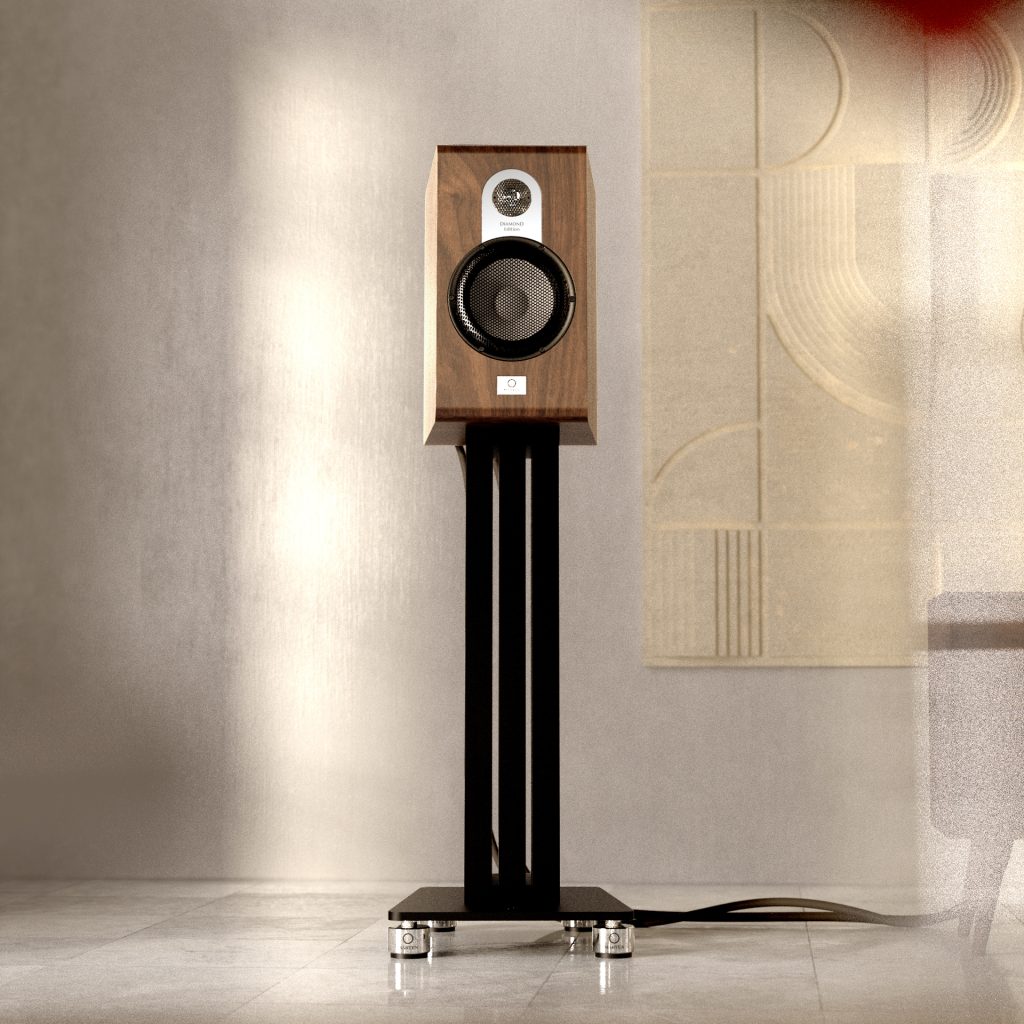
Q.V.S.T. is used on three of the four current Ø Audio models. The smallest model, the Frigg 02, uses a different and smaller waveguide — Ø Audio’s DXT — to horn-load just the carbon-fibre dome tweeter; the midrange and woofer are direct-radiating conventional drivers. The Frigg 02 sits at £12,995 and is the entry-point into the brand.
Above the Frigg 02, the Icon 12 (£19,995) is the first full Q.V.S.T. model, with the horn handling the midrange and treble and a 12-inch woofer handling the bass. The Verdande (£32,995) uses a larger Q.V.S.T. horn over a 15-inch woofer — Ø Audio describe it as their statement loudspeaker. The Ymir flagship (£59,995) uses the full-scale Ø Audio QVST waveguide and a 12-inch carbon-fibre composite woofer in a triple-rear-ported cabinet at 120 kg per side.
Why this matters in a domestic room
Two practical consequences in real listening. First, efficiency: an Ø Audio loudspeaker will play loud and clean on amplification that wouldn’t begin to drive a comparably-priced direct-radiating loudspeaker — which widens the choice of amplifier considerably, including back into low-power valve amplification where that is desired. Second, constant directivity: the sweet spot is wider, the imaging less brittle when you move on the sofa, and the room interaction more forgiving of furnishing and listening-room geometry. Both consequences are particularly useful in real homes, which is where these speakers will be living.
First impressions from High End Vienna
Theory is one thing; the listening room is another. Hidden Home Technology’s Daniel Crick heard Ø Audio’s flagship at High End Vienna, and sent these first impressions straight from the room:
“I’ve just been in the Ø Audio room and I’m kind of mind-blown — definitely starting to be converted to horns. It’s the scale of soundstage they produce, and the almost limitless size any one instrument can occupy within it. It’s just bigger than a traditional tweeter-and-woofer, non-horn speaker can produce. Really stunning. First impressions of their top model? It’s something else — refined, open, huge, dynamic, extended. A great speaker. Really, really impressed.”
The full range is available to audition by appointment at our Bath reference room. The four products are on our Ø Audio brand page; the broader hi-fi context is on our hi-fi page. To arrange a listening session, please use the contact form or call the showroom.
This is part of our coverage of High End Vienna 2026 — our highlights from the show floor.