Dan’s approach · Sound first, correction with purpose
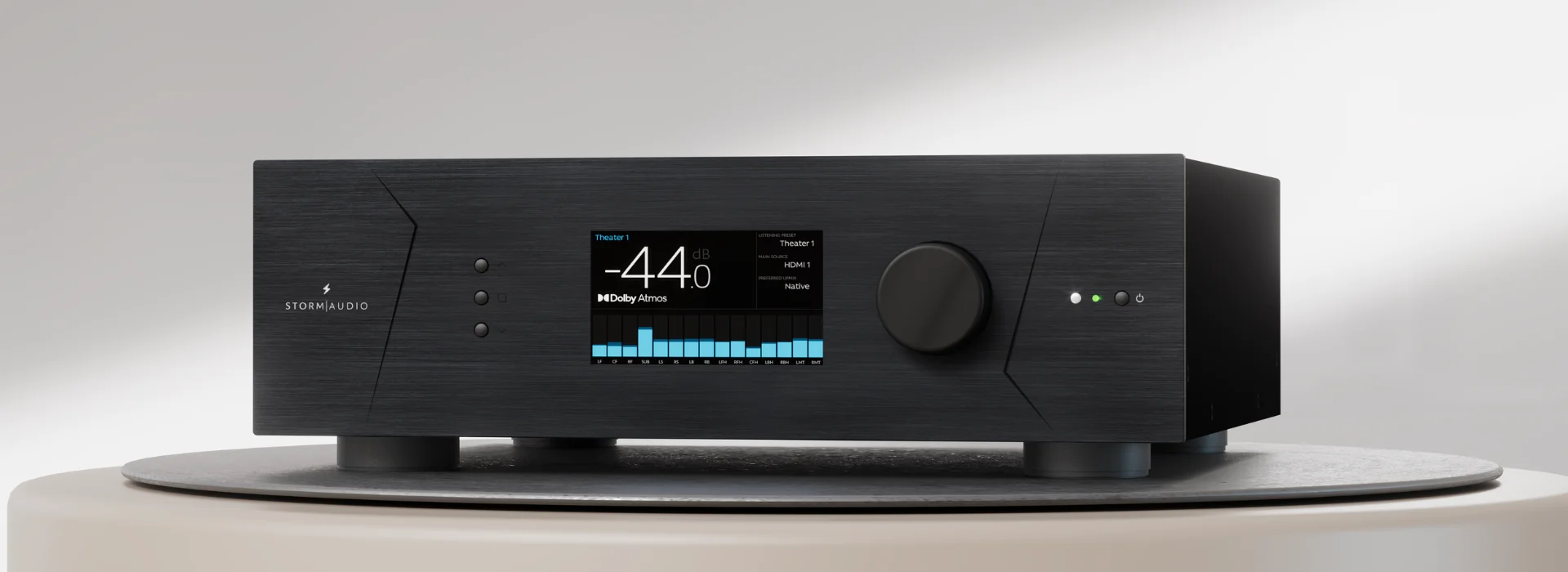
There is more to choosing StormAudio than Dirac ART. For Dan at Hidden Home Technology, its appeal starts with the sound of the complete system, the freedom to configure it carefully and the technical backup behind it. Active Room Treatment is another valuable tool—not the reason to skip the work that comes first.
Our approach is to start with speakers you enjoy listening to, integrate them properly with the subwoofers and room, then judge what further correction actually improves. If low-frequency energy is still lingering and masking detail, Dirac Live Active Room Treatment, usually shortened to Dirac ART, offers coordinated control using suitable speakers and subwoofers.
Start with speakers you like, not a correction target
Dan’s starting point is straightforward: choose loudspeakers whose tonal character you already like. He would not normally choose a speaker he finds too bright and plan to reshape its entire balance with a large shelving filter. Speaker choice, placement, amplification and the room should do as much of the work as possible before corrective EQ is added.
That does not mean avoiding calibration. Levels, distance and delay, polarity, phase around the crossover, and the handover between speakers and subwoofers all need attention. The aim is purposeful integration, with as little unnecessary tonal alteration as practical—not a blanket rule that fewer filters always sound better.
Manual calibration is a complete option
StormAudio’s calibration documentation describes up to 20 EQ filter cells per channel, with manual configuration and Room EQ Wizard filter import. Its owner’s manual also documents channel-EQ bypass, individual delays, levels and multi-way crossover controls. You do not have to run Dirac to make use of these tools.
This suits Dan’s preference for measuring first and applying specific adjustments: integrating multiple subwoofers, aligning their contribution with the main speakers and dealing with room modes where needed. Unneeded corrective EQ can be left out while essential decoding, routing and crossover functions remain in place. This is selective processing, not a claim that the cinema has a DSP-free signal path.
Much of that room-mode work is below the room’s Schroeder transition frequency, the approximate region below which individual room resonances become prominent. It varies with the room and its decay behaviour; it is not a universal crossover setting or the same thing as ART’s specified 20–150 Hz operating range.
We establish and assess the basic system before deciding whether Dirac adds a worthwhile improvement. If it does, the retained crossover, EQ and delay settings must be accounted for in the measured calibration configuration and the final result rechecked. ART is not something to switch on blindly over an unrelated filter setup.
What does Dirac ART actually do?
Imagine a bass note that should stop cleanly, but continues to rumble through the next sound. That lingering energy can blur rhythm and make a soundtrack feel less precise. Turning down the subwoofer may make the boom less obvious, but also takes away bass you wanted to hear.
Dirac describes ART as active control of the room’s low-frequency behaviour, operating from 20 to 150 Hz. Instead of correcting each loudspeaker only as an isolated source, it coordinates suitable speakers and subwoofers as a system. They can support one another to reduce unwanted resonances and shorten their decay.
This is more than asking an equaliser to flatten a response graph. The intended benefit is better control of how bass develops and stops over time, as well as how it varies around the listening area. The outcome still depends on the room, equipment, placement and calibration; it is not a promise of identical sound at every seat.
Three Dirac functions, three different jobs
It helps to separate the parts of the system:
- Dirac Live Room Correction: calibrates the loudspeaker system to improve its response in the room.
- Dirac Live Bass Control: manages subwoofer integration with the other speakers and with one another.
- Dirac Live ART: adds coordinated low-frequency support between suitable speakers to tackle room resonances and their decay.
ART does not make Bass Control redundant. Dirac states that a system using subwoofers needs the appropriate Bass Control licence as well as Room Correction and ART. StormAudio’s current Core and Evo product pages explicitly list all three as included. An existing installation should still have its exact processor, software and licence status checked before an upgrade is promised.
What could you hear?
The useful ambition is bass with more definition, not simply more bass. A kick drum should have an identifiable impact and finish. A sustained low note should reveal texture rather than excite one dominant room resonance. Film effects should retain weight without a prolonged rumble obscuring what comes next.
Better control can also help reduce the difference between a seat where bass dominates and another where the balance feels thin. How far that improvement extends is a design question. A single main seat, a sofa and two rows of cinema seating present different challenges, so the measurement area should reflect how the room will actually be used.
Why speaker capability still matters
ART does not turn a small ceiling speaker into a deep-bass subwoofer. The installer defines which speakers can support others and over what frequency range, guided by their usable capability and the measurements. Asking a loudspeaker to do work it cannot handle risks using up headroom rather than improving the cinema.
That makes subwoofer output, sensible locations and appropriate amplification important parts of the specification. Our recommendation is to preserve the system’s ability to reproduce demanding film peaks while controlling the room. Processor features should not consume the budget needed for capable speakers and subwoofers.
Dirac ART can operate with as few as two speakers, according to Dirac, so a large subwoofer array is not a universal entry requirement. That minimum is not a design target for every cinema, however. The practical question is whether the proposed system has useful acoustic support available where it is needed.
Active speakers: the processor can do more than correct the room
Dan has also configured fully active systems with crossover functions inside the StormAudio processor for suitable Wisdom Audio speakers. In this arrangement, the processor divides the signal into the bands needed by the separate driver sections, each with its own amplification. That is fundamental loudspeaker operation, not optional room correction.
StormAudio’s owner’s manual and Wisdom Audio crossover bulletin document multi-way operation and model-specific filter parameters. The exact speaker, approved filters, output count and amplifier channels must be designed together. This does not mean every Wisdom speaker needs an external active crossover, or that its required filters should be bypassed in pursuit of “less DSP”.
Support and the underlying audio design matter too
In Dan’s installation experience, StormAudio’s technical backup and support are major reasons to choose it. A processor is part of a system that must be commissioned, maintained and sometimes adapted years later; access to knowledgeable help matters alongside the headline features.
He also values the attention paid to the underlying audio circuitry, including the conversion and analogue output stages on models that use them. For Dan, technical competence is the starting point: the finished system must also be one he enjoys listening to. StormAudio’s hardware overview describes its dedicated processing architecture and hi-fi design roots. The complete implementation and listening result matter more than a DAC or op-amp part number alone.
The right model still depends on the wider system: Core provides analogue outputs, while Evo is a fully digital processor intended for a compatible digital audio chain. The choice has to match the amplification and speakers, not just the room-correction feature list.
Our award-winning Bath home cinema combines a StormAudio Core 16 with Wisdom Audio speakers. It is a real example of HHT’s system-led design work: the processor, speakers, room and installation are judged as a whole.
Does ART replace acoustic treatment?
No. Its active operating range is in the bass. Mid- and high-frequency reflections, overall reverberation, rattles and sound escaping into adjoining rooms remain separate concerns. Regular Dirac Live correction can be used above the ART support range where appropriate, but electronic correction is not a substitute for sound isolation or every form of passive treatment.
For HHT, the sensible approach is to design the room, loudspeaker layout, acoustic treatment and calibration together. ART is a valuable tool within that plan, not permission to ignore it. If you are comparing platforms, our StormAudio versus Trinnov guide explains the different approaches.
Talk to Dan about Dirac ART
Planning a new cinema or improving an existing one? Send Dan your room plan and equipment list, or call 07736 454506. The useful starting points are the seats you use, where speakers and subwoofers can go, and what currently disappoints you about the sound.
We can then discuss whether StormAudio with ART belongs in the solution, or whether layout, subwoofer capability or room treatment deserves attention first. Read more about our home cinema design and installation service.
Dirac ART questions answered
What is Dirac Live Active Room Treatment?
Dirac Live ART coordinates suitable speakers and subwoofers to reduce low-frequency room resonances and their decay. Dirac specifies an active range of 20 to 150 Hz. Results depend on the room, system capability and calibration.
Do you have to use Dirac on a StormAudio processor?
No. StormAudio provides manual EQ, delay, level and crossover controls, so a system can be calibrated without running Dirac. Optional corrective EQ is distinct from the processing needed for decoding, bass management and any active loudspeaker crossovers.
Does Dirac ART replace acoustic treatment or soundproofing?
No. ART targets low-frequency behaviour. It does not replace sound isolation or automatically resolve mid- and high-frequency reflections, reverberation and other room-acoustic issues.
Can an existing StormAudio system use Dirac ART?
Compatibility depends on the exact processor, installed software and licences. StormAudio lists Room Correction, Bass Control and ART as included on its current Core and Evo product pages. An older installation should be checked individually before an upgrade is specified.
Design perspective: Dan Crick, Hidden Home Technology, drawing on his installation experience. Technical references: Dirac ART FAQ, Dirac ART setup guide and the StormAudio documentation linked above. Checked 18 September 2026. The ART explanation describes the technology’s intended benefits; it is not a published controlled listening test.