Cables
Cables are the most argued-about category in hi-fi, so here is our honest position, arrived at over twenty-five years of installing systems and listening to the results.
A cable will not transform a system. Anybody who tells you it will is selling something. What a well-made cable does is stop the system losing things — through poor shielding, a badly made termination, inadequate conductor cross-section for the run length, or a connector that has worked loose in the eighteen months since it was fitted. In a resolving system those losses are audible, and removing them is worth doing. In a modest system, with a generic lead that is otherwise sound, the money is almost always better spent elsewhere. We will tell you which situation you are in.
The order to spend in
1. Get the basics right first — and they are free. Connectors clean and fully seated. Speaker cable of adequate gauge for the run — long, thin speaker cable measurably raises resistance and audibly softens bass control. Mains and signal cables separated rather than bundled together. Nothing coiled up behind the rack. This costs nothing and fixes more real problems than any upgrade.
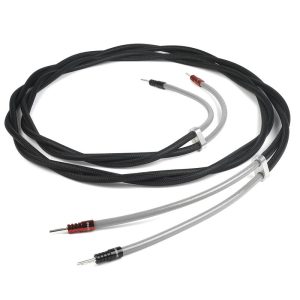
2. Speaker cable, if the run is long or the existing gauge is thin. This is where the physics is least controversial and the improvement most reliable.
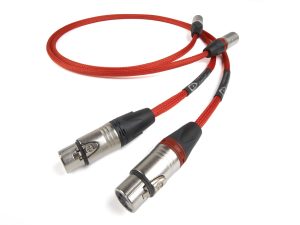
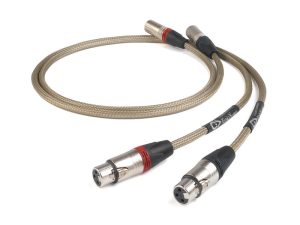
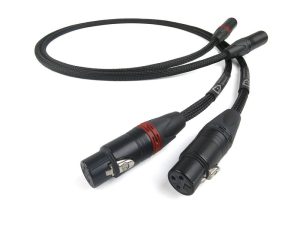
3. Interconnects, if the system is resolving enough to show it. Balanced XLR where your equipment offers it, particularly on longer runs, because the common-mode noise rejection is genuine engineering rather than opinion.
4. Mains and conditioning, last. Worth investigating once everything else is settled — and worth investigating properly rather than assuming.
Balanced or single-ended?
If both ends of the connection offer XLR, use it — especially over a run of more than about two metres, or where the cable has to pass near mains wiring, a router or a dimmer. If your equipment is single-ended RCA only, an adapter is not an upgrade; buy the right cable for the sockets you actually have.
What we carry: The Chord Company
We stock The Chord Company range, made in Wiltshire. Three tiers, and they behave as a ladder rather than as different flavours:
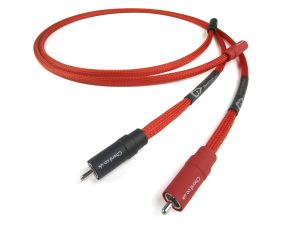
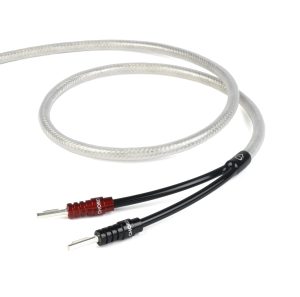
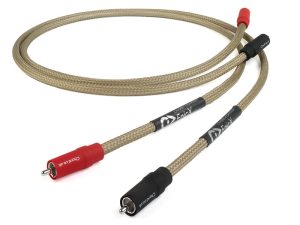
ShawlineX — around £210 to £330. The sensible starting point, and the tier at which most systems have gained everything they are going to gain. ShawlineX ARAY 2RCA around £210, ShawlineX speaker cable around £240, ShawlineX ARAY XLR around £330.
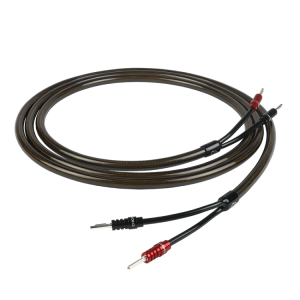
EpicX — around £360 to £660. Worth it in a system where the source and speakers are genuinely resolving. EpicX speaker cable around £360, EpicX ARAY 2RCA around £420, EpicX ARAY XLR around £660.
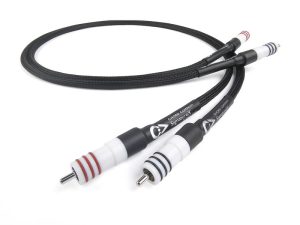
SignatureX — around £1,050 to £1,575. Reference-system cable, and only sensible once the room, the speakers and the electronics are all settled. SignatureX Tuned ARAY 2RCA around £1,050, SignatureXL speaker cable around £1,200, SignatureX Tuned ARAY XLR around £1,575.
A note on installations
If we are wiring a house or building a cinema, cable is specified at design stage and buried in the fabric of the building, so it has to be right first time — correct gauge for the run, correct type for the signal, and enough of it. Retro-fitting a cable into a finished wall is expensive; specifying it properly before first fix costs almost nothing. If you are at the planning stage, talk to us before the plasterboard goes on. See multi-room AV and smart home automation.
Not sure what you need?
Tell us what the equipment is at each end, how long the run has to be, and what the cable has to pass near on the way. We will recommend the tier we honestly think is worth it — including, quite often, that your existing cable is fine. Get in touch.
All prices shown include VAT. Hidden Home Technology is a family-run, CEDIA Professional Member business based in Bath.
Showing all 9 resultsSorted by price: low to high
-

Chord Company ShawlineX ARAY Analogue 2RCA to 2RCA
Accessories
From £300.00 -

Chord Company ShawlineX Speaker Cable Pair
Accessories
From £322.00 -
Chord Company ShawlineX ARAY Analogue XLR – Pair
Accessories
From £435.00 -

Chord Company EpicX Speaker Cable – Pair
Accessories
From £502.00 -
Chord Company EpicX ARAY Analogue 2RCA to 2RCA
Accessories
From £600.00 -
Chord Company EpicX ARAY Analogue XLR – Pair
Accessories
From £870.00 -
Chord Company SignatureX Tuned ARAY Analogue 2RCA to 2RCA
Accessories
From £1,440.00 -
Chord Company SignatureXL Speaker Cable – Pair
Accessories
From £1,560.00 -
Chord Company SignatureX Tuned ARAY Analogue XLR – Pair
Accessories
From £2,040.00