Power Amplifiers
A power amplifier does one job: take the line-level signal from a preamplifier and turn it into something capable of controlling a loudspeaker. Separating that job from the delicate, low-level work of source switching and volume control is the reason serious systems move to separates — the most electrically violent stage in the chain gets its own chassis, its own power supply and its own earth, well away from anything sensitive.
Our range runs from around £1,080 to £97,500, in stereo, monobloc and multi-channel forms. Here is how to choose.
Watts are the least useful number on the page
Doubling the power buys three decibels. That is a small change. What actually separates amplifiers at the same nominal rating is how they behave when the loudspeaker’s impedance drops and the music demands current in a hurry — which is exactly when most amplifiers get into trouble and exactly what no specification sheet describes.
The practical questions we ask are: what are the speakers, how big is the room, how loud do you really listen, and does the speaker have a reputation for being a difficult load. That gets to the right answer far faster than comparing wattage.
Stereo, monoblocs, or multi-channel?
Stereo — one box, two channels. Simplest, and right for most two-channel systems.
Monoblocs — one chassis per channel. Each has the whole power supply to itself and can sit next to its loudspeaker, so the speaker cables get short and the interconnects do the long run. In big systems this is a genuine advantage, not just a display of intent.
Multi-channel — for cinema and for whole-house audio, where the alternative is a rack of stereo amplifiers and a great deal of heat. Channel count, not per-channel glory, is the design goal.
Valve or solid state?
Valve amplifiers present the midrange differently and many listeners prefer them for it. They also run hot, weigh a great deal, and have tubes that are consumables. Solid state gives control, consistency and no maintenance. Neither is correct; both are choices, and this is a decision to make with your ears rather than from a table.
The things that actually go wrong
Under-matching. An amplifier that sounds effortless on an easy speaker can sound strained on a demanding one at the same volume. This is the commonest fault we are called out to.
Ventilation. Serious amplifiers dissipate serious heat. Built into a sealed cabinet without airflow, they will either shut down or age quickly. Plan the rack before you buy the amplifier.
Gain mismatch with the preamplifier. Get this wrong and you end up with all your usable volume in the first eighth of the dial, and audible hiss. It is easy to avoid at specification stage and annoying to fix afterwards.
Mains supply. A large amplifier deserves its own radial circuit. In an install we specify this at first fix; retro-fitting it later means chasing walls.
What we carry
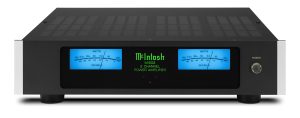
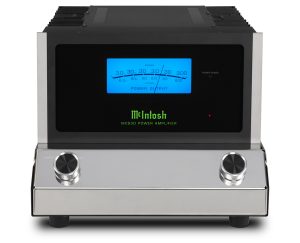
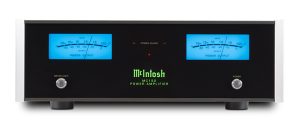
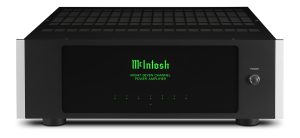
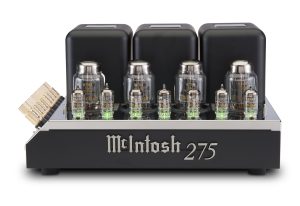
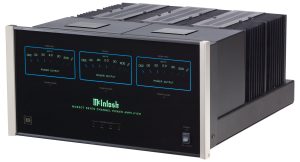
McIntosh — much the widest choice here: solid-state stereo such as the MC152 around £7,990 and MC462, the valve MC275 around £8,990 and MC1502, monoblocs from the MC611 to the MC2.1KW around £66,990, and the MI-series multi-channel amplifiers for cinema and whole-house work.
Gryphon — Essence around £21,250, Antileon EVO, Mephisto and the Apex at £97,500. Amongst the very few amplifiers in production that will drive any loudspeaker on the market to its limit.
TAD — the M1000, M2500 Mk2 and the reference M700.
Naim — the NAP250, plus CI-series install amplifiers for multi-room work.
Mola Mola — the Perca around £7,299. Compact, cool-running and very quiet.
Lyngdorf — the SDA-2400, rack-mountable for integrated systems.
Next steps
Tell us the loudspeakers, the room and the preamplifier, and we will match rather than guess. Where possible we would rather you heard the combination — get in touch to arrange an audition at our Bath showroom. See also pre-amplifiers and loudspeakers.
All prices shown include VAT. Hidden Home Technology is a family-run, CEDIA Professional Member business based in Bath.
Showing 1–18 of 40 resultsSorted by price: low to high
-

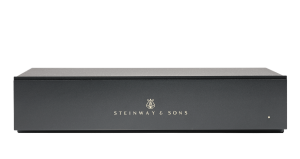
Steinway & Sons A2
Power Amplifiers
POA -
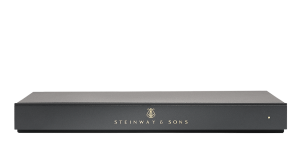
Steinway & Sons A1
Power Amplifiers
POA -

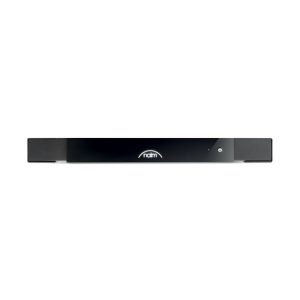
NAIM CI-NAP 101 Mono Power Amplifier
Power Amplifiers
£1,082.50 -
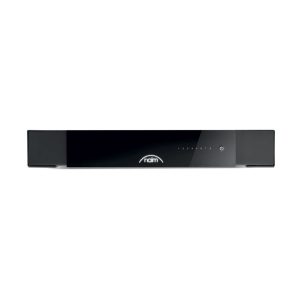
NAIM CI-NAP 108 – 8 Channel Power Amplifier
Power Amplifiers
£2,165.83 -

Lyngdorf SDA-2400, Incl. Trigger Cable & Rack Mount, 4 RU
Power Amplifiers
£2,600.00 -

McIntosh MI128 8-Channel Digital Amplifier
Power Amplifiers
£5,890.00 -

McIntosh MI1250
Power Amplifiers
£5,890.00 -
Naim NAP250 2-Channel Power Amplifier
Power Amplifiers
£6,200.00 -

McIntosh MI502 2-Channel Digital Amplifier
Power Amplifiers
£6,490.00 -

McIntosh MC830 1-Channel Solid State Amplifier
Power Amplifiers
£6,990.00 -

Mola Mola Perca Stereo Power Amplifier
Power Amplifiers
£7,299.00 -

StormAudio Impulsion 8 – 8-Channel Class D Power Amplifier
Power Amplifiers
£7,376.45 -

McIntosh MC152 2-Channel Solid State Amplifier
Power Amplifiers
£7,990.00 -

McIntosh MI347 7-Channel Digital Amplifier
Power Amplifiers
£8,490.00 -

McIntosh MC275 2-Channel Vacuum Tube Amplifier
Power Amplifiers
£8,990.00 -

McIntosh MC8207 7-Channel Solid State Amplifier
Power Amplifiers
£9,495.00 -

Trinnov Amplitude16 – 16-Channel Power Amplifier
Power Amplifiers
£10,275.00 -

StormAudio PA 16 – 16-Channel Power Amplifier
Power Amplifiers
£11,950.99